Through academic sources, many authors highlight the environmental benefits of E-Commerce, or online shopping: the most obvious environmental drivers are energy (Weber et al. 2008i, Edwards et al. 2010ii) and resource savings (Matthews, Hendrickson and Soh (2001iii). At the end of the twentieth century, Coheniv (1999) predicted ten Internet trends that might likely become green practices, including E-commerce. Compared to traditional shopping, online shopping eliminates car trips and their associated emissions, and reduces inventories, waste and retail space (energy consumed mostly from lighting and cooling).
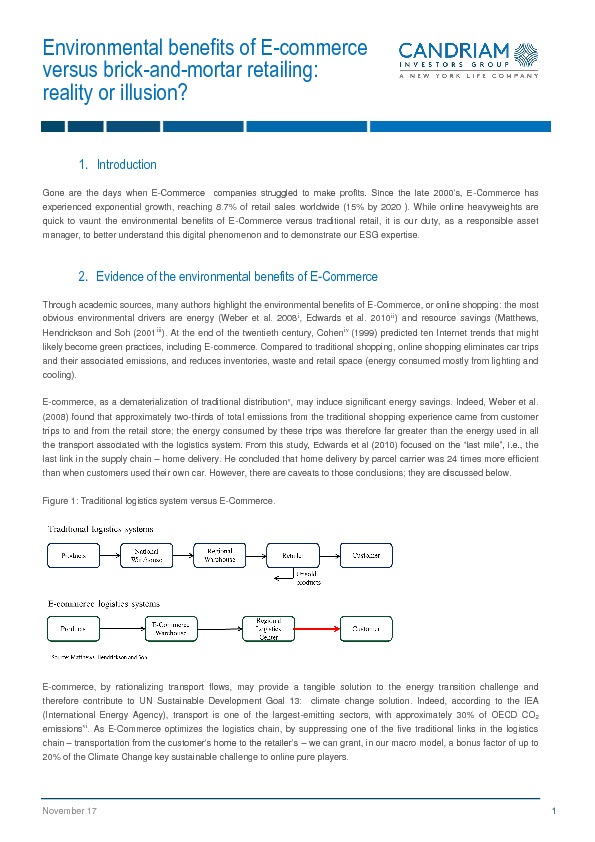
E-commerce, as a dematerialization of traditional distributionv, may induce significant energy savings. Indeed, Weber et al. (2008) found that approximately two-thirds of total emissions from the traditional shopping experience came from customer trips to and from the retail store; the energy consumed by these trips was therefore far greater than the energy used in all the transport associated with the logistics system. From this study, Edwards et al (2010) focused on the “last mile”, i.e., the last link in the supply chain – home delivery. He concluded that home delivery by parcel carrier was 24 times more efficient than when customers used their own car. However, there are caveats to those conclusions; they are discussed below.
Continuer la lecture de cet article ?
Inscrivez-vous gratuitement et obtenez un accès à
Investment Officer France:
Investment Officer France:
- Exclusif pour les investisseurs professionnels
- Annulez à tout moment
- Accès illimité : web, application et newsletters
L'inscription prend moins d'une minute.
Aucune information de paiement requise
Inscrivez-vous gratuitement et obtenez un accès à
Investment Officer Belgique:
Investment Officer Belgique:
- Exclusif pour les investisseurs professionnels
- Annulez à tout moment
- Accès illimité : web, application et newsletters
L'inscription prend moins d'une minute.
Aucune information de paiement requise
Inscrivez-vous gratuitement et obtenez un accès à
Investment Officer Luxembourg:
Investment Officer Luxembourg:
- Exclusif pour les investisseurs professionnels
- Annulez à tout moment
- Accès illimité : web, application et newsletters
L'inscription prend moins d'une minute.
Aucune information de paiement requise