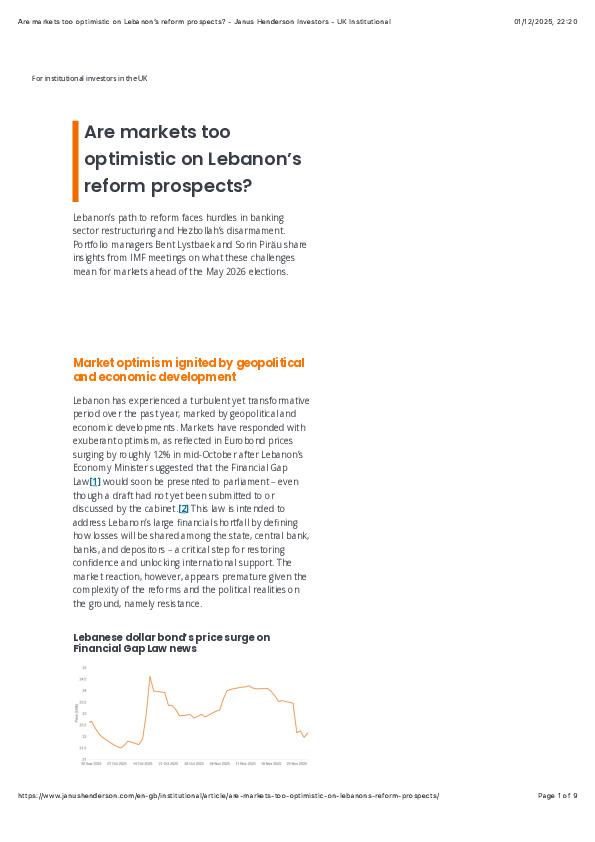
This analysis examines why market enthusiasm for Lebanon’s Eurobonds may be outpacing the political and institutional capacity to deliver credible reform
-
Eurobond prices surged after news of forthcoming Financial Gap Law proposals, yet IMF discussions revealed that both banking-sector restructuring and Hezbollah’s disarmament face structural obstacles unlikely to be resolved before the May 2026 elections (pages 1–4)
-
The Bank Restructuring Law still requires 11 IMF-mandated amendments, while the Financial Gap Law debates—deposit losses, gold reserves, and claim hierarchy—pose political risks that could delay implementation well beyond current expectations.
-
IMF officials and bondholder advisers stressed that international support hinges on credible reforms and de-escalation with Hezbollah—conditions not reflected in current pricing and widely viewed as improbable in the near term.
To dig deeper into why the reform timeline risks slipping and how investors might reassess valuations as political headwinds build, explore the full report.
Continue reading this article?
Register for free and get access to Investment Officer International:
- Exclusive for professional investors
- Cancel anytime
- Unlimited access: web, app and newsletters
Registration takes less than 1 minute.
No payment details required
Register for free and get access to Investment Officer Luxembourg:
- Exclusive for professional investors
- Cancel anytime
- Unlimited access: web, app and newsletters
Registration takes less than 1 minute.
No payment details required