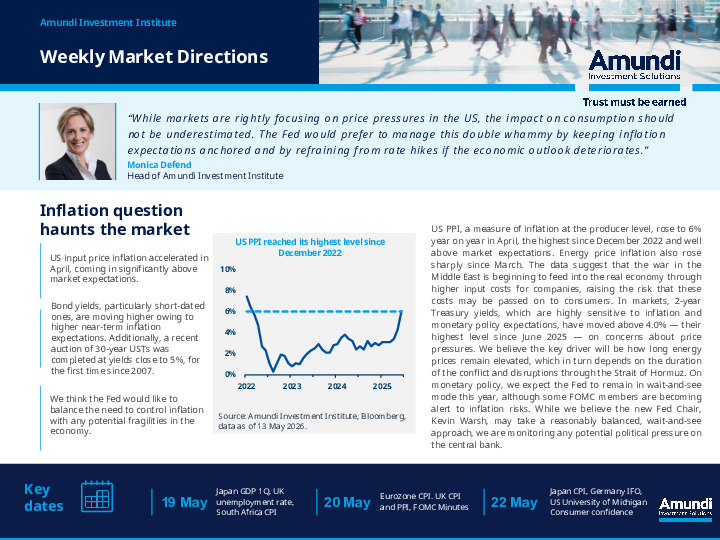
Amundi argues that markets are increasingly confronting a form of inflation driven less by domestic demand and more by geopolitical fragmentation and energy insecurity.
- US producer-price inflation accelerated to 6% year-on-year in April, its highest level since late 2022, largely driven by rising energy costs linked to Middle East tensions.
- Treasury yields, particularly at the short end, moved sharply higher as markets repriced the possibility of prolonged inflation and fewer Federal Reserve rate cuts.
- Amundi sees the Strait of Hormuz as the critical variable: the longer disruptions persist, the greater the pass-through from energy costs into the real economy.
- The report also highlights an emerging policy dilemma for the Fed — balancing inflation control against weakening consumption and broader economic fragility.
The larger message is that inflation is no longer purely a monetary phenomenon. Energy chokepoints and geopolitical conflict are beginning to shape pricing dynamics directly.
Continue reading this article?
Register for free and get access to Investment Officer International:
- Exclusive for professional investors
- Cancel anytime
- Unlimited access: web, app and newsletters
Registration takes less than 1 minute.
No payment details required
Register for free and get access to Investment Officer Luxembourg:
- Exclusive for professional investors
- Cancel anytime
- Unlimited access: web, app and newsletters
Registration takes less than 1 minute.
No payment details required