
How a UCITS ETF delivers its index exposure matters – particularly in US equities, where synthetic replication can offer a structural advantage over physical replication. Portfolio Managers Natasha Sibley and Ben Jones explain the difference between the two approaches, what drives the costs of a synthetic ETF, and why keeping those costs as low as possible is central to delivering an efficient outcome for investors.
Exchange traded fund (ETF) investing has transformed the way investors access markets. Over the past two decades, the range of exposures available has grown significantly, while costs have continued to fall. For investors building a core allocation to a major market such as US equities, a passive ETF offers a simple, low-cost way to capture the return of the index.
But not all passive ETFs are built the same way. How an ETF obtains its exposure – its replication method – can have a meaningful impact on how much of the index return ultimately reaches the investor.
Physical and synthetic replication: two routes to the same index
Passive ETFs generally obtain their index exposure in one of two ways.
A physical ETF buys and holds some or all of the securities in the index. It may hold every constituent in the same proportions as the index, or an optimised sample designed to reduce trading costs. Physical funds may also lend out securities to help offset some of the drags on performance.
A synthetic ETF typically holds a basket of equities and enters into a swap agreement with a counterparty, usually one or more large banks. Under the swap, the fund exchanges the performance of its basket for the performance of the index. The counterparty is contractually obliged to deliver the index return, which allows for precise index exposure.
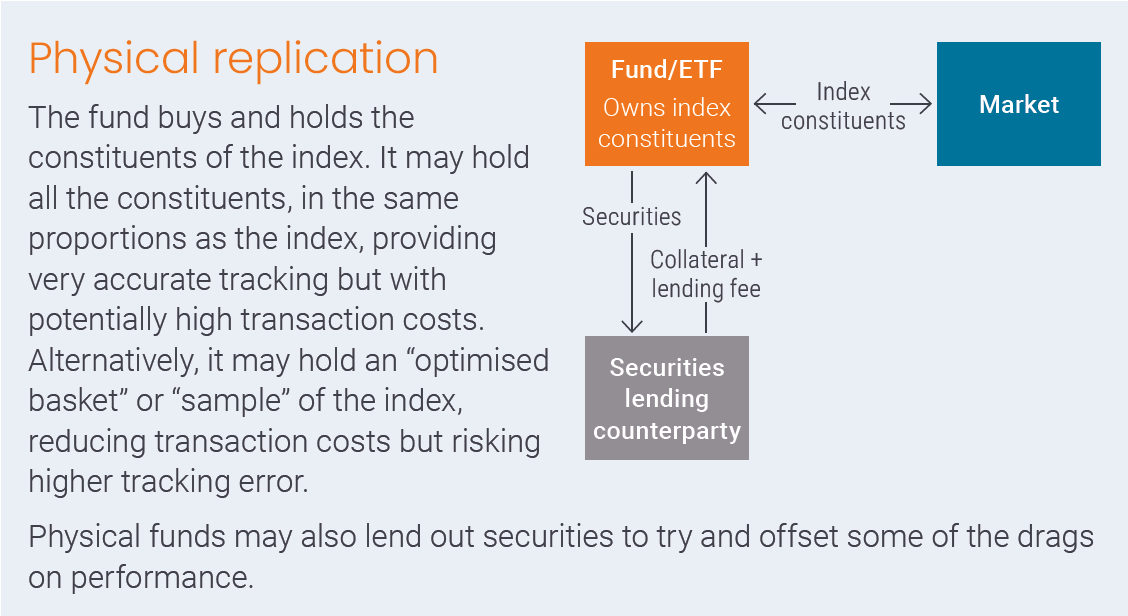
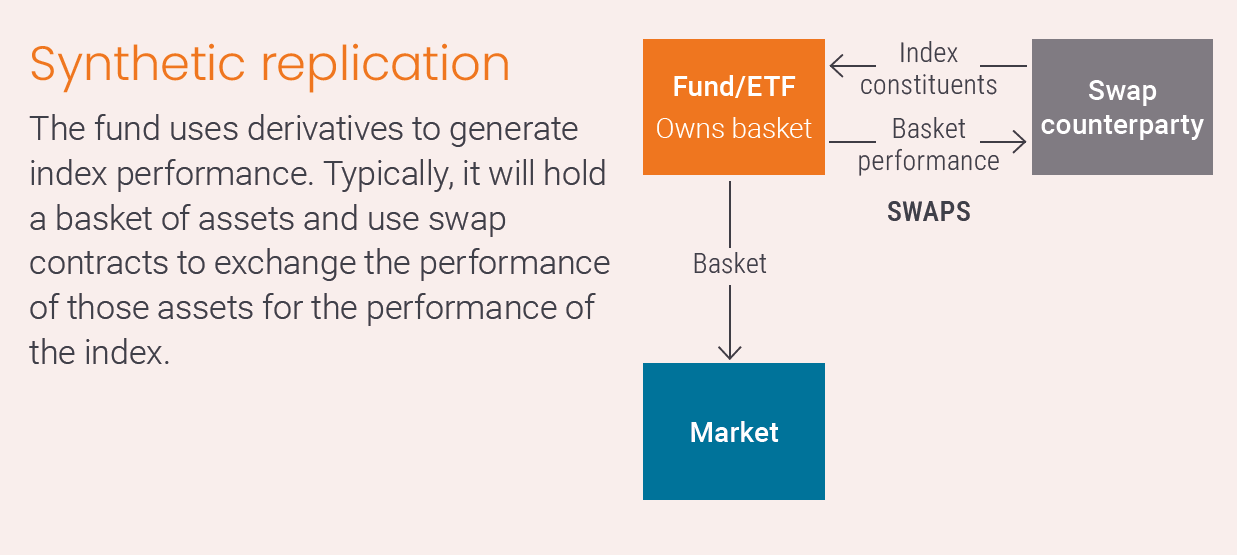
Source: Janus Henderson Investors. For illustrative purposes.
Both are well-established approaches. Which one is more efficient depends on the market being tracked – and in US equities, tax is often the deciding factor.
Why synthetic can have the edge in US equities
Many US companies pay dividends, and those dividends are subject to withholding tax when paid to non-US investors. A European-domiciled physical ETF that holds US shares directly will typically have 15% or 30% of every dividend withheld at source. That tax reduces the income retained by the fund and is a permanent drag on returns compared with the index.
The impact is not trivial. As a hypothetical illustration, if a broad US equity index had a dividend yield of 1.3%, a 15% withholding tax would cost a physical fund roughly 0.2% a year (1.3% × 15% ≈ 0.195%) before any other costs are considered.
A synthetic ETF works differently. The swap counterparty delivers the total return of the index. Under US tax rules, swaps referencing qualifying indices are generally not subject to the same dividend withholding tax, which means a synthetic ETF can receive the index return with dividends reinvested without the 15% deduction.
For investors that would otherwise face withholding tax on US dividends, this structural advantage means synthetic ETFs have historically outperformed their physical equivalents over time.
Understanding the costs of a synthetic ETF
All passive ETFs face drags on performance, be it from tax, transaction costs, costs of running the fund or imperfect replication. For an investor in a synthetic ETF, the drag versus the index traded is a combination of two elements:
- The total expense ratio (TER): the annual cost of managing the fund, deducted from fund assets.
- The swap spread: the cost charged by the swap counterparty for delivering the index return.
Together, these represent the gap between the return of the index and the return the fund delivers. At Janus Henderson, we disclose both components on our website so investors can clearly understand what they are paying for and how much of the index return they can expect to receive.
What determines where fees and swap spreads are set?
Several factors influence the level of the TER and the swap spread:
- Market financing dynamics. Swap counterparties price their spreads based on their own costs of funding and hedging the exposure they deliver, as well as wider demand for that exposure across the market. These conditions change over time, which is why swap spreads can move.
- The cost of building and running the product. An issuer faces a range of costs in bringing an ETF to market and operating it, including fund administration, custody, listing and benchmark licensing fees paid to index providers.
The issuer’s role is to manage these costs efficiently – negotiating competitive swap terms, controlling operating costs and structuring the product to minimise performance drag.
The bottom line
For investors building core exposure to US equities, the replication method is important – as is the headline fee.
Physical ETFs that hold US shares directly typically lose part of every dividend to withholding tax. A synthetic structure may deliver the full index return without that deduction. For many investors, that makes it the more efficient way to own the US market.
That efficiency comes at a cost, and it should be transparent. For a synthetic ETF, the gap between the index and the fund comes down to the TER and the swap spread. Both depend on market financing conditions and on what it costs to build and run the product.
Our role as an issuer is to manage both efficiently and disclose them clearly, so investors can understand the principal costs associated with the exposure.
An efficient structure, delivered at a competitive cost, can help reduce performance drag for investors.